
The coding agent that asks before it assumes.
Seam holds multiple plausible interpretations of a task, asks one precise clarifying question, and safely builds the shared part while decisions are still pending.
"Add state persistence to the workspace editor."
"Should local edits sync to IndexedDB immediately, or buffer until explicitly saved?"
Shared Common Core Building Now
AST serializer & state schema implemented immediately. Zero code lost regardless of your choice.
// Paradigm Shift
Speculative guessing breaks codebases. Seam preserves intent.
Coding agents are fast at the wrong interpretation.
Software requirements are often underspecified. Current agents usually choose one interpretation and proceed with confidence:
Seam keeps ambiguity explicit.
Forkpoint Engine holds multiple plausible interpretations, asks one question that separates them, and starts the shared work immediately:
How Seam eliminates speculative rewrite loops.
From ambiguity detection to non-destructive execution in four deterministic phases.
Hypothesis Generator
Parallel Spec Synthesis
Holds 2-3 plausible interpretations of the prompt concurrently in isolated speculative trees instead of forcing an early guess.
// Empirical Benchmarks
Quantifiable safety across real-world codebases.
Average code preserved vs standard agent discard rate
Invariant core predicted before developer clarification
Unsolicited spec mutations committed to production git branch
Built for developers who value precision over guesswork.
Explore real interface screens from Seam: task ingestion, discriminating questions, and the automated decision matrix.
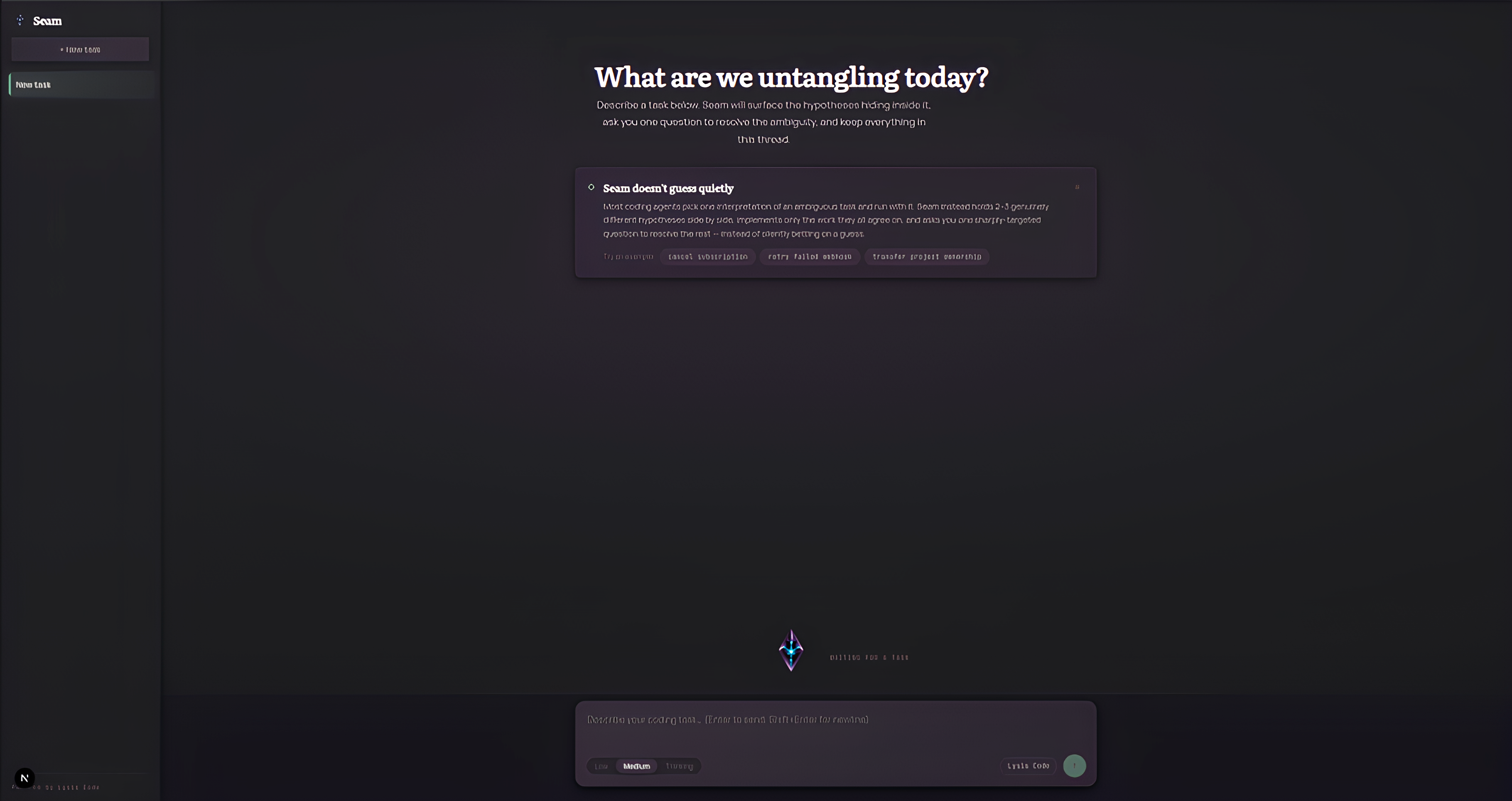
Aporen Roadmap
From speculation-safe code synthesis to autonomous market validation and 3D game engines.
Seam
Speculation-safe AI coding agent
Holds multiple specs, asks discriminating questions, and safely builds the shared core without code churn.
Seam is the foundation of Aporen's speculation-safe architecture. By executing the invariant common core while divergent specs await developer decision, Seam eliminates wasteful rewrite cycles and false-positive code churn in real-world repositories.
Sandbox
Validate before you build
Sandbox works with you, not just for you. You draft an idea, the system asks clarifying questions the same way Forkpoint does for code — surfacing what actually needs to be decided (e.g. speed to market vs. defensibility) — and you refine the idea together.
It has real browser access: it finds actual competitors, pulls their real pricing, features, and positioning, and checks whether your idea already exists — assembled into a comparison table with sources, not assumptions.
Instead of a single verdict, it builds 2-3 concrete scenarios for your idea (narrow niche/fast launch, broad positioning/long build, or a middle path with a specific differentiator) and asks one key question that determines which path fits.
Output is a structured artifact: a market snapshot with real links and prices, a SWOT specific to your idea, and an explicit confidence label on every claim — what's verified by search versus what's model inference.
Aporen Games
One line to a playable 3D game
- 01 —Orchestrator & Game Specification: reuses Seam's existing Hypothesis Generator, Decision Differ, and Question Selector with a game-domain system prompt. One line in, Forkpoint finds the core decision (e.g. combat vs. exploration vs. survival), output is a structured Game Specification.
- 02 —Gameplay logic: Qwen3-Coder-30B-A3B (and Qwen3-Coder-Next for heavier cases), fine-tuned via SFT on trajectories — task → architecture → code → runtime trace → bug → patch → passing test — the same training approach used for Seam, applied to a new domain.
- 03 —Concept art & characters: Qwen-Image for generation, Qwen-Image-Edit to preserve character identity across frames. LoRA fine-tuning is not expected to fix weak base-model geometry or anatomy.
- 04 —3D asset generation: Hunyuan3D and TRELLIS / TRELLIS.2. Deliberately not fine-tuned yet — a weak 3D dataset would teach the model to reproduce its own topology/UV/scale defects.
- 05 —World Generation + World Compiler: a generated scene is not a playable level. A separate deterministic World Compiler layer builds the scene graph — real collisions, navigation, spawn points, and gameplay zones — on top of the generative output.
- 06 —AI Playtester: objective, binary pass/fail checks only — does it launch, does it crash, can the player pass through the door, is FPS above 60. Whether the game is fun is explicitly left unautomated.
- 07 —Repair Loop: play → find bug → fix → save the trajectory → fine-tune. The compounding proprietary failure-to-repair dataset is the long-term value — individual models in the stack are treated as replaceable.
Quiet precision. Zero third-party telemetry.
Aporen is a solo-founder AI studio based in Almaty, Kazakhstan, building fully local, self-hosted coding agents — custom fine-tuned LoRA adapters served through vLLM, zero third-party inference dependency in production.
We believe software engineering tools should operate with total technical transparency. Seam runs entirely inside your infrastructure on local GPU/NPU compute, preserving strict data isolation while guaranteeing that no speculative edit is ever applied without verifiable AST invariants.
Self-hosted vLLM + custom LoRA stack. Zero network traffic to external LLM providers during agent synthesis.
Custom domain-adapted model weights trained on held-out tasks for hypothesis generation and AST diff safety.
Get early access to Seam.
Join developers using speculation-safe AI agents to eliminate refactoring loops. We are rolling out invites in batches.